Tuesday, January 13, 2015

Bats near Bangkok


Going Batty

 
It was my the end of my first week in Bangkok , I had spent the time writing up a consulting assignment I had just finished in Cambodia and I was going batty. When my long-time friend Budsabong called me up and invited me to go check out a bat colony with her on Saturday I jumped at the chance.  Spending a day in the countryside looking at bats with an old friend, what could be better!

Since I first worked with Budsabong on otters in Thailand more than 30 years ago she has risen to the high ranks of the Royal Thai Forestry Department, and is now in charge of the Wildlife Research Division.  She had heard about a large fruit bat colony in Samat Prakan Province south of Bangkok where the Chao Phraya River empties into the Gulf of Thailand.  She wanted to find this colony to send her veterinary team out later to catch some bats and take blood samples for DNA and disease studies.  So, on Saturday she and her little Pekinese/Chihuahua sidekick Nemo, and her government car and driver, Samit, picked me up at my downtown Bangkok apartment and we were off!

Driving to Samat Prakan was no problem, but then we had find the bats. We parked along the docks, and Budsabong and Samit set to work asking locals about bats, while I happily babysat Nemo and took photos of the old Buddhist temple (wat) situated nearby.  Evidentially it was determined that these bats were on an island protected by the Thai military.  No problem for us.

With the help of a public boat that diverted a bit from its usual course we were soon walking down the dock of a military compound amidst bold signs in Thai, which I presumed were warning us away.  Camouflage-geared soldiers met us, some Thai words were exchanged, and I was nervous.  But no reason to be as it turned out.  
 
The soldiers led us past an ancient ruined fort with moats and brickwork and moss growing around crumbling stones.  As we passed one opening, everyone, soldiers, Budsabong and Samit alike all stopped to hold their hands in prayer, while looking at some sort of shrine deep inside the ruined building, When I asked, I learned that this was an old piece of the front end of a boat found at the bottom of the gulf and installed in a shrine where people revere it for the good luck it brings.  So, what the heck, I honored it too, with folded hands and solemn demeanor and then caught up with the group walking ahead of me on a boardwalk through a pristine estuarine forest of nipa palms and mangroves. 

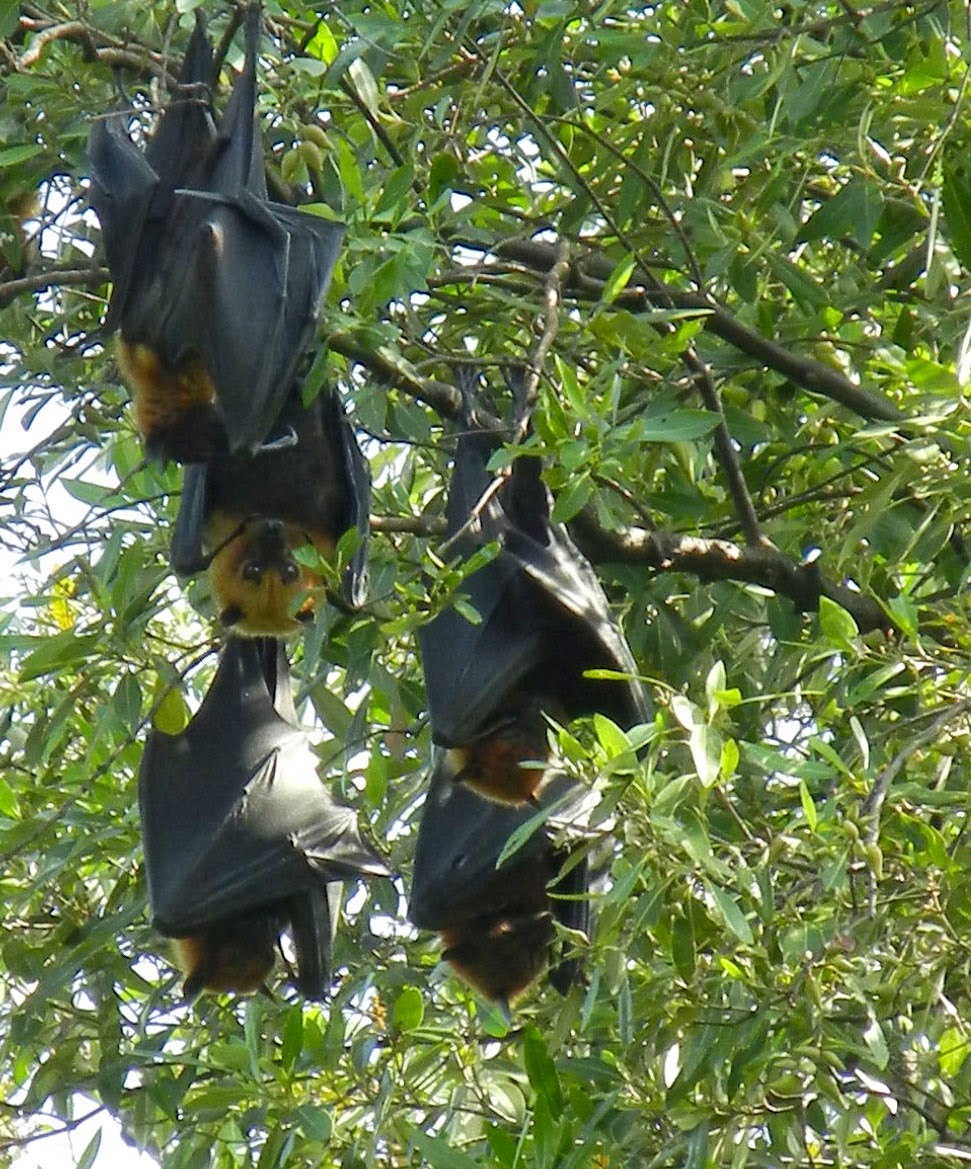
Minutes later we were in the midst of more fruit bats than I’ve ever seen in all my life. Hundreds of these “flying foxes” were disturbed by our presence and flew above us, chirruping their dismay.  Hundreds more stayed hanging from their tree branches, watching us with wide-awake eyes, waiting for us to pass.  Samit and I happily took photos while Budsabong chatted in Thai with the soldiers, trying to find out as much as she could about the colony.  All the while little Nemo pulled at his leash, terrified of all the commotion overhead.

Eventually our team of soldiers, biologists, driver and dog left the bats, but the outing was still not finished.  Budsabong had convinced the soldiers to take us in a boat ride around the island, to see the bats from this vantage point which would not disturb them into flight.

So, we all climbed into a little skiff for a boat tour.  On one side of the waterway human development crowded out the scene.  A large port and vessels and huge concrete warehouses and even taller apartments behind these cluttered the view.  But on the other side, on this island protected by the military, it was all natural mangroves and taller trees, all of them with branches loaded with giant fruit bats. 

As we cruised along and took more photos, I admired the cormorants and egrets, just like ours, which stood along the mudflat shores.  Here and there I spotted a decorated floating woven palm Frisbee-sized disk, full of flowers and bright-colored decorations, remnants of millions of these that were released in Thai waterways just two days before during the Loi Krathong Festival.
Eventually the soldiers brought us fully around their wonderful nature preserve of an island and up to a rickety ladder up a muddy bank which we gingerly climbed, and ended up right beside our car in the parking lot.  Mission accomplished.  And time for lunch!

Pi Pi Island is Dead and Gone


It’s thirty years since I first went to Pi Pi Island, Thailand with Bucko and a lot has changed here, and not for the better.  Well I guess that depends on your perspective.  If you are a developer with interests on this island it’s a better world than before.  But if you enjoy seeing live coral, and smooth uncluttered sandy beaches and native tropical vegetation covering the inland mountain, it’s just too bad.  All this is gone.

I’m traveling memory lane here in Thailand, revisiting friends and places from long ago, and with a free weekend to escape from the city, Pi Pi Island made it to the top of my list.  It’s worlds away from Bangkok, but not really. All it took was a taxi, a plane, a minivan, a ferry, a long-tailed boat and 8 hours from start to finish and I was sitting on the beach waiting for my fresh prawns to be cooked with the Andaman Sea lapping at my feet.

Sounds great, right?  Well that was before I ventured further the next day.  I took a half-day boat trip, with the masses, to see the famous sights.  Monkey Island, Maya Beach, Viking Cave and even some snorkeling thrown in.  Bring it on!  

But what a let down.  No longer the pristine place of long ago, this place is crowded!  I was on one of maybe 20 1/2day tourist boats, packed cheek to cheek with twenty people crowded into narrow benches.  But I was in front and could see the scenery.  Good right?  Well even from my vantage point I could barely take a photo without another boat in the picture, hundreds of boats, not only snorkel boats like mine, but large speed boats crammed with economy passengers and small speed boats hired by the wealthy and here for the day.

The first stop, Monkey Island, was really the edge of the subsidiary island here, where a feeding platform lured in monkeys.  Our boat waited in a line of other boats waiting to get our chance to get close and let foolish passengers try to get their picture taken while the monkeys looked for their chance to bite them.

Next stop, Maya Bay, the location where the The Beach was filmed in 1999, a movie about people trying to get away from it all on a secluded beach in southern Thailand.  Not so secluded now.  We had to pay an additional $5 just for the opportunity of crowding in with dozens of other boats of all sizes, all discharging passengers for 40 minutes of walking thru crowds on the beach, or swimming with the masses.  It reminded me of the beaches in New Jersey in my younger days, where you couldn’t even find a place to spread your towel.  No thanks, I’ll just wait on the boat.

Oh and then there was the snorkeling stop.  Hurray, I was going to see the colorful coral and sea fans and butterfly fish and angel fish and giant clams I remembered from my last visit here.  I was the first to jump off the boat with my prescription mask in hand.  Let me at it!

But no.  The coral here was all dead, bleached chunks of rock now, lifeless. The butterfly fish and angelfish and parrotfish that feed on live coral?  Gone.  The live sea fans in all colors?  Gone.  All there was were a few sergeant major fish and sea cucumbers—both common signs of degraded marine ecosystems, and a few pale sea anemones with the most common type of clownfish hiding in the tentacles.  

The situation on land on Pi Pi Island is similar.  It is chock a block full of hotels and cabanas and huts and all around the sounds of construction of many more. The walkways are cluttered with trinket shops, massage and tattoo parlors, bars and restaurants all full of mostly European and Japanese tourists, thousands of them all crowded on the walkways and beaches of this little island only 5 miles long and 2 miles wide.  The once vegetation-covered hill in the interior is now full of hotels all the way to the top and down again on both sides.  And most seem to be full to capacity.  Pi Pi Island, it seems is THE place to go.

The developers and builders and tourist operators are obviously making a killing here, but what has already been killed is the natural beauty of the place. To me, despite the hubbub, Pi Pi Island is dead and gone. 

And, I couldn’t help thinking about another island I still hold dear to my heart, Amelia Island.  Please people, let’s not let this happen to us!

Monday, January 12, 2015

Elephant Karma November 2014


Elephant Karma

It seems here in Thailand I’ve landed in a little whorl of elephant karma.  Never have elephants figured so prominently in my life.  Of course, years ago when I worked at Marine World Africa USA some of my friends were elephant keepers so I knew some of their elephants close up and personally.  But really, elephants always scared me, and rightly so.  They are quite capable of killing people and do so, in both captivity and in the wild.  I have always been respectful but admired elephants at a distance.
  
But here in Thailand this trip I find myself immersed in elephants.  Last week I took a train up to Lampang to visit an old Marine World friend and former elephant keeper, Richard Lair.  He moved to Thailand more than 30 years ago to study elephants, helped found the Thai Elephant Conservation Center (TECS) and he is still here, married to a Thai woman.

My day with Richard at TECS was great, and I left totally impressed with the care of their elephants and their commitment to their health and well-being.  In Thailand elephants were long used for transportation and for logging forests but they have since been replaced by roads and modern machinery.  Elephants are long-lived and expensive to maintain, and they need to earn their keep. Now, their only work is in the tourist trade, with some elephant facilities better than others. 
  
The elephants at TECS have a good life.  The fifty plus elephants here, retired from logging, or orphaned in the wild when elephant poachers kill the adults for their tusks, are put in different situations depending on their talents.  Some of them carry tourists on their back for rides.  Some perform in logging demonstrations, or paint   pictures, or play drums in shows for tourists. But none put in more than four hours a day of work, only four days a week. Between shows they are given daily baths in the lake, and fed lots of good quality food. At night they are tethered on long chains out in the forest where they can wander and select their own foods to eat.
 
Some of the elephants here are being taken care of at the elephant hospital.  Three elephants there lost part of their legs to land mines, and are fitted with prosthetic limbs.  Elsewhere two orphaned baby elephants are being taken care of by “wet nurse elephants”, cows whose calves have already been weaned but still have milk, and readily take to a new offspring to raise as their own.

TECS is a government-run facility and the mahouts have an equally good life at the center, working civil service jobs, with their housing provided, and health care, school for their children and retirement subsidies. Elsewhere in SE Asia, at private run facilities this is not the case and both elephants and mahouts are over-worked and “under paid”.

It wasn’t only captive elephants I learned about this trip to Thailand, but wild ones too. I spent a weekend with my friend Sompoad Srikosamatara and his graduate students in a village on the Burma border where wild elephants and humans have had negative interactions including deaths on both sides.

The villagers were moved to this elephant area when their former homes in the valley were flooded by a dam.  The elephants attacked their huts, ate their crops, etc at first, but Sompoad’s students have been helping the villagers devise non-lethal ways to keep them away.  And, the weekend I was there the villagers were holding an “elephant merit-making” festival to help people understand and appreciate elephants and to reward the wild elephants too, with spiritual things like blessings by monks, and practical things like salt licks too. 


The day long festival included people from three different ethnic groups, all living near this village, with the children and most adults dressed in their traditional clothing.  Monks chanted prayers, dignitaries like Sompoad gave talks about elephants, students painted pictures of elephants for a contest, various groups performed traditional dances and songs, women cooked and served lots of their traditional food, all for free, as part of everyone’s “merit making”.


At one point we all signed a large piece of orange cloth with our names and good words about elephants and helped tie it on a huge tree.  Later on we all traipsed into the forest to help dig holes and add salt to make a salt lick as a gift to the elephants in an area they frequent with elephant dung to prove it.
I was the only farang (non-Thai) at this festival and felt very fortunate to be there.  I left with a better appreciation for elephants and an even stronger love for the Thai people too!

Return to Taman Negara November, 2014


When I think of tropical rainforests I will always picture Taman Negara, the premier national park in Malaysia and the first rainforest I ever spent time in.  Thirty years ago Bucko and I traveled there at the behest of the government of Malaysia to survey otters in this park.  For two weeks we traveled with rangers and boatmen up and down the river on long-tailed boats seeking the tracks, scat and other signs of the two species of otter that most probably lived here.

It was the time of our life, but we were young then, and such things were easier.  Now, with thirty years of age and a similar amount of weight accumulated, I was eager to go back again, expecting the worst but driven to go there nonetheless.

This time there was no government support for my visit and no research to conduct.  Instead I went as a regular tourist on a “3 day, 2 night package” out of Kuala Lumpur.  All details were taken care of.  At 8 AM one morning I boarded a minibus, at 11 AM I was at the boat dock in Kuala Tembeling and by noon I was riding with a group of other tourists on a long-tail boat for the three hour journey up the river to the park headquarters.

The river was broad, like I remembered, the big sandy beaches were devoid of people and the old growth rainforest trees towered high above the water’s edge. On the surface, at least, during the ride upriver, things had not changed all that much. 

So, lulled into complacency I was not ready for the sight of the visitor area in the park.  Where once there had been only a single lodge and campground on one side of the river, now there were scores of hotels, countless guest houses and a dozen or more floating restaurants, a regular city here in the jungle.  But lucky for me it was the rainy season, off-season in these parts, and most of the beds and tables were empty.  Believe me, I don’t ever want to go there in peak season and neither do you!

Even though I was part of a tourist package I was eager to break out of the mold, and the pictures Bucko suggested I carry with me did the trick.  Thirty years ago, like now, I was snapping photos of everything, using slides then, but converting the best images into prints.  And this handful of prints included photos of the local boatmen who accompanied Bucko and I on our otter survey.  Sure enough when I showed these photos to local guides they took me to two of these men, retired now, that still lived in the area.  Although I still can’t speak Malay and they still can’t speak English, the words “memerang” (otters) and Shabrina (my counterpart) were evident in their excited comments.  They remembered Bucko and I and our otter study.  And now they have the photos to prove it.

The second day at Taman Negara I managed to break away from the tour group in another way.  Our group was loaded onto a small long-tail boat and taken to a concrete dock up the river, at the base of 200 steep railing-less concrete stairs leading upwards to the canopy walkway, another bunch of stairs to the top.  This walkway, a series of 10 rope bridges suspended about 1/3of mile in length gave an exciting view of the rainforest and river below and I’m glad I experienced it.  But by the time I climbed up the stairs and up to the walkway, I was beat.  “OK, now we are climbing to the top of the mountain, another 1000 stairs,” said our guide. Not me.  I arranged with our guide to meet them back at the boat dock.


And this was a wonderful idea.  I purchased some soft drinks from a ranger at the walkway, then got the boatman to take me up the river to a local Orang Asli community I had noticed on a nearby beach.  I climbed up the bank to the cluster of huts, called out to alert people, then dropped the sodas off at the entrance to one of them as a gift.  Eventually two children came out of a hut, sipping their sodas and smiling shyly at me, not a tourist encounter at all.
The boatman soon came to pick me up and take me to a place closer to the dock where he could watch for the tour group returning from their mountain trek.  And me?  I jumped into the Tembeling River once again and floated there, fully clothed, alone but for the boatman, enjoying my memories of times gone by.  My visit to Taman Negara was a success!